Sheela-na-gigs
I once visited a temple in India where all the statues were,
well, rude. They were so rude, in fact, that they even offended my
rather broad upbringing, (courtesy of the British Army). Perhaps one
even expects to find such statues in foreign places, but one would
never think that Shropshire contained them.
The truth of the matter is that three churches in Shropshire contain
sheela-na-gigs. One of these three churches contains two, and the total
of four in the county make up almost twenty-five percent of the total
number in the country!
A sheela-na-gig is a rather crude sculpture, a sort of
three-dimensional pin-up, and normally comprises a grinning, squatting
woman with legs wide apart, and, usually, because of their age, the
details are fortunately worn to an extent that they can no longer be
discerned easily. The carvings are always primitive which implies
either work by early, unskilled masons, or perhaps work by masons
recreating something from an earlier age.
The original purpose of these statues is unknown, some believe they may
have been some sort of fertility symbol, others that they are of Norman
origin and are no more or less than early Christian art. But what is
strange is that they have survived through the centuries which brought
puritanism, morality and the Reformation. Not only have they survived
but they have, on occasion, even been replaced because of popular
opinion, after having been first removed by pious Christians.
Generally, those that have survived are to be found in rural churches,
which is not strange when one considers that country folk have always
had a different approach to sex than have townsfolk. Perhaps that is
because, being country folk, we are daily surrounded by, and reminded
of, the reproductive cycle, be it animal or plant.
The examples in Shropshire can be found at Church Stretton,
Holdgate and Tugford.
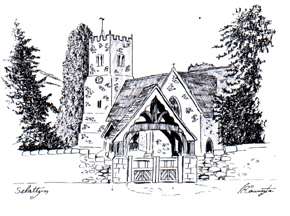
The church at Church Stretton is a large and dignified structure with
Norman origins. The statue can be found outside over the north doorway.
It is probably not in its original position, which implies that it was
removed from an earlier structure, or at least moved to its present
position when the church was altered.
Holdgate and Tugford churches are both to be found in the parish of
Tugford in Corve Dale. Holdgate has a deserted feel to it as it was
once a much larger settlement. It was once called Castle Holdgate, as a
motte and bailey castle was built soon after the Norman Conquest. In
1280, Robert Burnell built a fortified manor house here, before he
built at Acton Burnell, and the church was built at the same time.
It is worth remembering that the king wanted Burnell to become the
Archbishop of Canterbury, and thus it is unlikely that such a man would
have allowed his church to be built with a pagan image on the wall if
it had offended the Christian morals of that time. The statue can be
found on an outside wall of the chancel. Again, it seems that this is
not its original position.
Tugford church stands only a mile or so from Holdgate and was an
established village at the time of the Domesday Survey. A reference to
a chapel here dates from as early as 1138, and here can be found two
sheela-na-gigs flanking the doorway. Yet again, they seem to have been
moved from their original position.
I suppose we will never know the true origin of these unusual statues.
Each theory as to their origin can be made convincing, if stated with
sufficient conviction, and each theory can be disputed by yet another
theory. Personally, I am rather pleased we will never know their true
meaning or origin. Because of this lack of knowledge, they will most
likely survive, if only as a curiosity, but something ought to be done
to preserve them as their detail is slowly diminishing. I should hate
for them to deteriorate to a point where I had to explain exactly what
the woman depicted in each sculpture was doing!
|